

Feet: why the trim cycle matters more than almost anything you buy.
The hoof is the only part of the horse that touches the ground, and it is the part owners most often leave to run long. A late trim is not a cosmetic problem: it can change how the whole limb loads.
No foot, no horse. It is the oldest line in the business because nobody has managed to disprove it.
A horse’s hoof wall grows continuously, roughly a quarter to three eighths of an inch a month in an adult horse, faster in warm weather and slower in winter. In the wild that growth is worn off by constant movement over abrasive ground. Domestic horses stand on soft footing, move a fraction as far, and carry a rider. The growth still happens. The wear does not.
So the trim is not maintenance in the sense that washing a truck is maintenance. It is the only thing keeping the foot the shape the horse’s tendons, joints and bones are built to load.
This page is general education from a horse trainer who trims. It is not veterinary advice and it does not replace your own farrier or vet. Anything sudden, severe, or involving heat and a strong digital pulse is a phone call, not a web page.
What actually goes wrong when a trim runs late
This is worth understanding once, because it explains nearly every hoof problem an ordinary owner runs into.
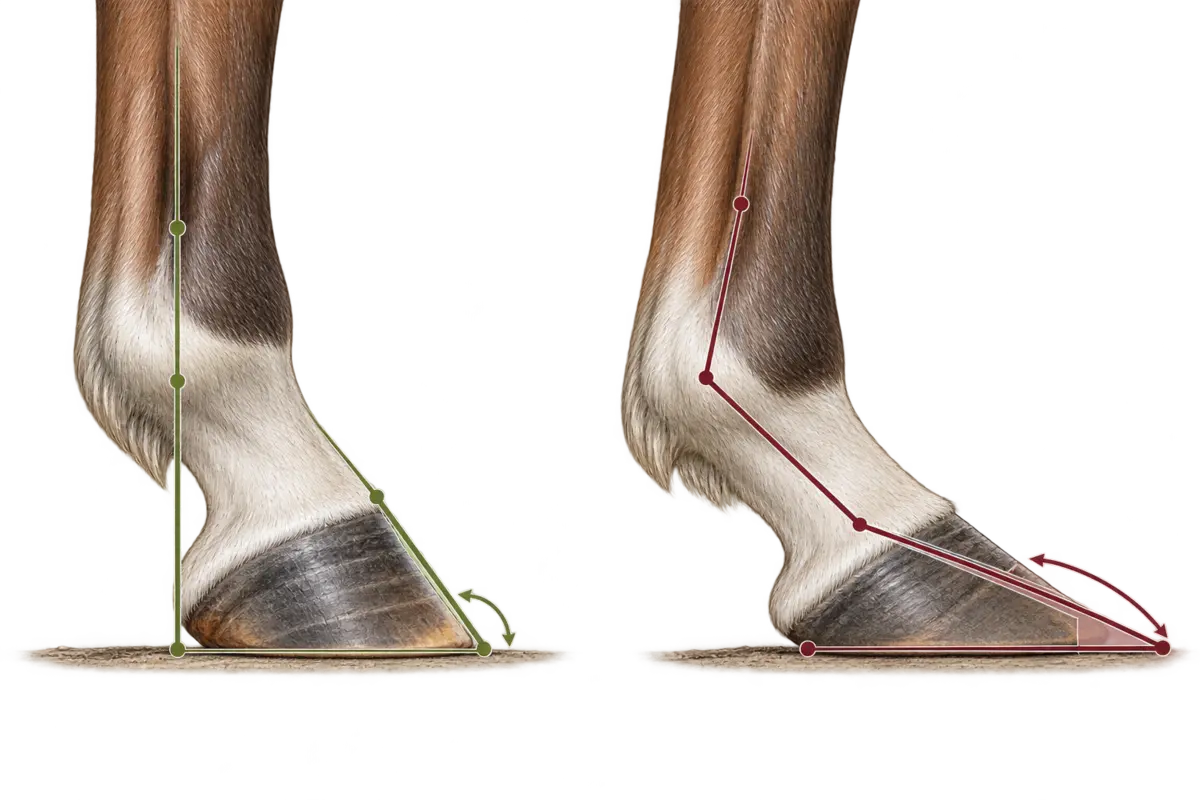
As the foot grows, it does not grow evenly downward. The toe grows forward and the heels run forward with it. Two things follow, and they compound.
1. The lever arm gets longer. Breakover, the moment in the stride when the heel has lifted and the horse rolls over the toe, moves further out in front of the joint. Every stride now works a longer lever against the front of the foot. That pulls on the laminae, the interlocking tissue holding the hoof wall to the bone inside it, and it increases tension in the deep digital flexor tendon running down the back of the leg.
2. The heels stop supporting weight. As they run forward and collapse under, they lose the ability to carry load, so more of it shifts onto the frog, the digital cushion and that same tendon. Sole gets flatter and thinner. Bruising, separation and cracks follow.
None of this is dramatic on any single day. That is the trap: it happens slowly enough that the owner adjusts to it, and it usually gets noticed as a performance change rather than a foot problem. A horse that has become short strided, reluctant to go forward, or stumbly is a horse worth looking at the feet on before anything else.
How often, honestly
There is no single right number, but there is a right principle: trim on a calendar, not on how the foot looks. By the time a foot obviously needs doing it has usually been working a longer lever for a while.
The intervals below are common starting points, not prescriptions. Growth rate varies with the individual horse, the season, the footing, the workload, nutrition and any pathology in the foot, so the right cycle for your horse is one your farrier sets by watching how that horse's feet actually grow, and then revisits.
| Situation | Usual interval | Notes |
|---|---|---|
| Shod horse in work | About 4 to 6 weeks | Reset before the shoe has migrated with the growth. |
| Barefoot horse in regular work | About 4 to 6 weeks | Short cycles keep the foot close to balanced the whole time instead of swinging between extremes. |
| Barefoot, light use or turned out | About 6 to 8 weeks | Some pasture horses on abrasive dry ground self trim usefully. Most do not. |
| Very light use, ideal footing | Sometimes 10 to 12 weeks | Long, and not an outer limit that applies to every horse. Plenty of horses need work sooner than this, and some genuinely go longer. Eyes on the feet in between, and let your farrier set the interval for this horse. |
| Foals and youngstock | Shorter, and early | Limbs are still forming. Small, frequent corrections now prevent permanent conformation problems. |
| Any horse with a hoof problem | Whatever your farrier and vet say | Rehabbing a distorted foot generally means shorter cycles, not longer. |
Growth changes with the season, and so does the interval
Hooves generally grow faster in warm weather and more slowly in cold, and the interval usually moves with it. University of Minnesota Extension suggests trimming or shoeing at least every 6 to 8 weeks in summer, and every 6 to 12 weeks in winter. Precisely because growth slows, the winter interval is often the same or longer, not shorter. That is a starting point rather than a rule: the same source notes the interval “may be different between horses based on their hoof growth”. Watch the foot, and let your farrier set the cycle for this horse.
Short cycles are cheaper than long ones
A small trim every five weeks costs less than rehabbing a flat, bruised foot with crushed heels, and far less than the time off that comes with it.
Consistency beats perfection
A decent trim on a reliable schedule beats an excellent trim whenever somebody gets around to booking one. The foot is a moving target; the schedule is what keeps up with it.
The honest answer
Lazy K does barefoot trims, and that is a genuine preference, not a neutral one. It is worth being clear that it is a preference. The claim that shoes stop circulation in the foot is not something this page will make, and "barefoot is biomechanically superior" is not an established fact about every horse. Hoof mechanics, shoeing and their effects on the structures inside the foot are actively researched and genuinely contested, and the honest position is that the right answer depends on the individual horse, their feet, their work and the ground they live on.
What can be said plainly: plenty of horses who were told they could never go without shoes do well once the trim and the footing are sorted out, and that is worth exploring with a farrier who is willing to. It is not a promise, and it is not a reason to leave a horse sore.
That is not the same as saying every horse should be barefoot. Some horses need shoes: thin soles on rocky country, specific pathologies, therapeutic work, certain jobs and certain conformation. A horse that is genuinely footsore without shoes is telling you something, and the answer is not to make them wait while somebody proves a point.
Boots are the middle ground people forget. A well fitted hoof boot for the rough rides, and bare the rest of the time, works for a lot of horses in this valley.
What matters more than the barefoot argument
- The cycle. A long trim cycle produces the same mechanical problems barefoot as it does in shoes. Peripheral loading, laminar strain, flat soles. Going barefoot does not exempt anybody from the calendar.
- The transition. Pulling shoes and riding the same rocky trail on Saturday is how people conclude their horse cannot go barefoot. Give them time, boots, and a conditioning plan.
- The footing the horse lives on. Feet adapt to the ground they stand on all day, not to the ground you ride on twice a week.
- The diet. Horn is protein and minerals. See the supplement guide, particularly the section on biotin, which is the best evidenced supplement ingredient there is for hoof quality.
What to do between visits
Pick the feet out, and actually look
Daily if you can, and every time before and after you ride. Picking feet is not really about the rock. It is the thirty seconds a day when you would notice heat, a change in the frog, a nail, a crack getting longer, or a horse that suddenly does not want to give you that foot.
What you are looking for: a foul smell or black, oily discharge around the frog (thrush), a soft or ragged frog, cracks that reach the coronet, a spongy or crumbly spot in the white line, heat, and a digital pulse you can feel strongly at the fetlock.
Manage the ground the horse stands on
Most hoof infection problems in this valley have an environmental component. Thrush is a degenerative infection of the frog involving a mixed population of bacteria and fungi, and it is associated with wet, packed, airless conditions, though it also occurs in horses on dry ground, so a clean surface is not by itself a guarantee. A clean, dry place to stand is the foundation of both prevention and treatment, and it works alongside daily picking, an appropriate topical product and, where the frog shape or loading is part of the picture, the farrier.
Dry footing at the gate and around the feeder, clean bedding, manure picked up, and enough turnout that the horse is moving. Movement pumps blood through the foot, which is most of what builds a good one.
What you are most likely to run into
Thrush
What it is: a degenerative infection of the frog involving a mixed population of bacteria and fungi, typically in the airless crevices either side of it. Classic signs are a foul smell and black, oily discharge, a frog losing its shape, and tenderness through that area. It is associated with wet, dirty footing rather than caused only by it. Horses on dry ground get thrush too, which is usually a sign that something about the frog's shape or how it is being loaded is part of the story.
What to do: clean, dry footing, daily picking, and an appropriate topical product used consistently rather than once. Cutting away frog tissue is a farrier or veterinary decision, not a job to do yourself with a hoof knife. It is easy to remove healthy tissue or open the sensitive structures underneath. Anything deep, anything that makes the horse sore, anything with a discharge you would call pus, and anything not improving within a couple of weeks needs your veterinarian and farrier looking at it together.
Worth knowing: thrush is usually treated as a hygiene problem, and it is, but a contracted or poorly shaped frog that never gets loaded properly sets it up. Trim and movement are part of the fix.
White line disease
What it is: a separation in the hoof wall that gets colonized by opportunistic organisms. It generally starts at the ground and works upward, hollowing out the wall from inside. It often looks minor at the bottom and is much larger underneath.
What to do: this is farrier and vet work. Treatment means opening the affected area, removing all the diseased horn so oxygen gets to it, and then treating the exposed tissue. Painting something on the outside of an intact wall does not reach it.
Worth knowing: it is frequently a downstream problem. Distortion, long cycles and wall separation are what give it somewhere to start.
Hoof abscess
What it is: infection tracking up inside the hoof capsule, usually after something got in through a crack, a nail hole, or a bruised area. Wet weather raises the risk.
What it looks like: often a sudden, severe, lameness where the horse will not put weight on the leg that appears overnight with no injury. Heat in the foot and a strong digital pulse. It genuinely looks like a broken leg to an owner seeing it for the first time.
What to do: call your vet or farrier. An abscess resolves by draining, and getting it to drain is a job for someone who knows where to open it. Soaking and poulticing help; digging at it yourself does not.
Good news, as these things go: once it drains, most horses are dramatically better very quickly.
Cracks, chips and flares
Small chips at the bottom edge are usually a trim cycle question. Cracks that run vertically and reach up toward the coronet, or that open and close as the horse moves, are a farrier question and sometimes a vet one.
Flare, where the lower wall bends outward away from the bone, is a sign the wall is being stressed and the connection is stretching. It is the visible version of the lever arm problem at the top of this page.
Bruising and thin soles
Red or pink staining in the sole is old bruising working its way down. Recurrent bruising means the foot is not getting enough protection, whether from sole depth, trim balance, footing, or the work being asked.
The answer is rarely to trim more off. Often it is to trim less sole, shorten the cycle, change the footing, and use boots while the foot builds depth.
Laminitis and founder
This one is an emergency and does not belong on a self help page. Signs include reluctance to walk, a rocked back stance trying to get weight off the front feet, heat in the hooves, a strong bounding digital pulse, and short pottery steps that are worst on hard ground or turning in tight circles.
Call the vet immediately. Get the horse off grass and onto soft footing, and do not force them to walk any further than they must. Hours matter here.
Most cases have a metabolic cause. If your horse is an easy keeper, cresty necked, or has ever had an episode, read the metabolic section of the supplement guide and get bloodwork done before it happens again.
Farrier or vet?
Your farrier
- Routine trims and resets
- Chips, small cracks, flare, balance questions
- Thrush and white line, in the first instance
- A shoe lost or twisted
- Whether this horse can go barefoot
Your vet, now
- Sudden severe or lameness where the horse will not put weight on the leg
- Any suspicion of laminitis
- Heat plus a strong digital pulse
- A puncture wound in the sole. Leave the object in place and call, so its depth and direction can be seen on an x ray
- Anything that does not improve, or that keeps coming back
The best outcomes happen when those two talk to each other. If your horse has a real foot problem, get the vet’s radiographs into your farrier’s hands. Trimming to what the bone is actually doing beats trimming to what the outside of the hoof looks like.
A horse that will not stand for the farrier is a hoof problem
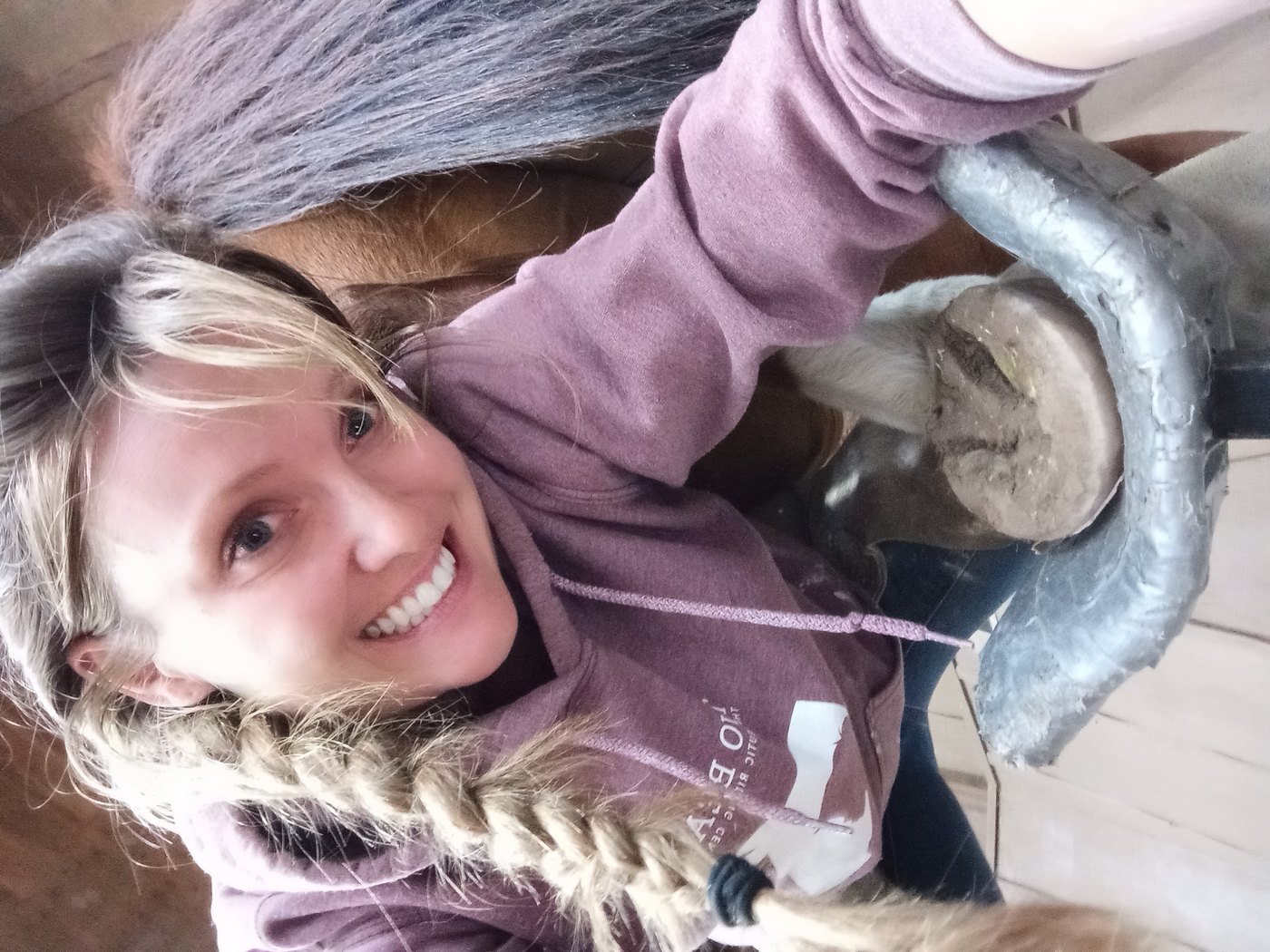
Everything above assumes somebody can pick that foot up and work on it for a few minutes without a fight. Plenty of horses cannot, and the consequences are not social. They are physical.
A horse that snatches their feet away, leans, kicks or panics gets rushed trims, because a farrier working on a dangerous horse is working fast, not well. That horse gets longer cycles, because everyone quietly puts off booking it. And eventually they get dropped, because good farriers have full books and do not need to get hurt. In a valley this size, word travels, and finding the next one is genuinely hard.
So the foot goes long, the lever gets worse, and the horse gets sorer, which makes them even less willing to stand on three legs while somebody holds the fourth. It is a loop, and it is very common.
It is training, not restraint
A horse that will not give you a foot is not being disrespectful. Standing on three legs while a stranger holds the fourth is genuinely difficult for a prey animal, and most horses that fight it were either never taught properly or were hurt while it was being done.
The fix is the same as everything else here: build it slowly, ask for a small try, release for it, and never make the horse pay for being worried.
This is what Lazy K’s farrier service is built around. Gentle, patient barefoot trims, specializing in horses who are difficult about their feet, with the goal of a calm trim rather than a fast one. The handling gets taught, not forced, so the next trim is easier than the last.
It is also the most honest test of a training program there is. A horse that picks up all four feet for a stranger was taught something real.
See the farrier serviceTrims, or help with a horse that fights them
Call or text and describe what is happening. If your horse needs a vet or a specialist rather than a trim, Kat will tell you that.