
Where this horsemanship comes from.
None of this was invented at Lazy K. It comes down a documented line, from the California vaquero tradition through the Dorrance brothers, and forward into a modern understanding of what is actually happening in a frightened horse’s brain.
Plenty of trainers say they are “rooted in the vaquero tradition.” Fewer can name the chain. This page exists so you can check the work. Every person here has published books, videos or a website, and every one of them is linked.
Two circles, not one list. The first six are the people this horsemanship is built on. The second six shape how it’s taught: the working line that still carries it, the science that explains why it works, and the proof that it still wins in open competition.
The horse is not the problem. The horse is telling you the truth about the situation.
Who learned from whom
Solid lines are direct instruction. Dashed lines are collaboration. Everything on the left came out of the California and Great Basin vaquero tradition; the branch on the right arrived separately and independently reached a lot of the same conclusions.
Where Lazy K actually connects to this
Plenty of people claim a lineage. Here is the documented version, and it is two steps long.
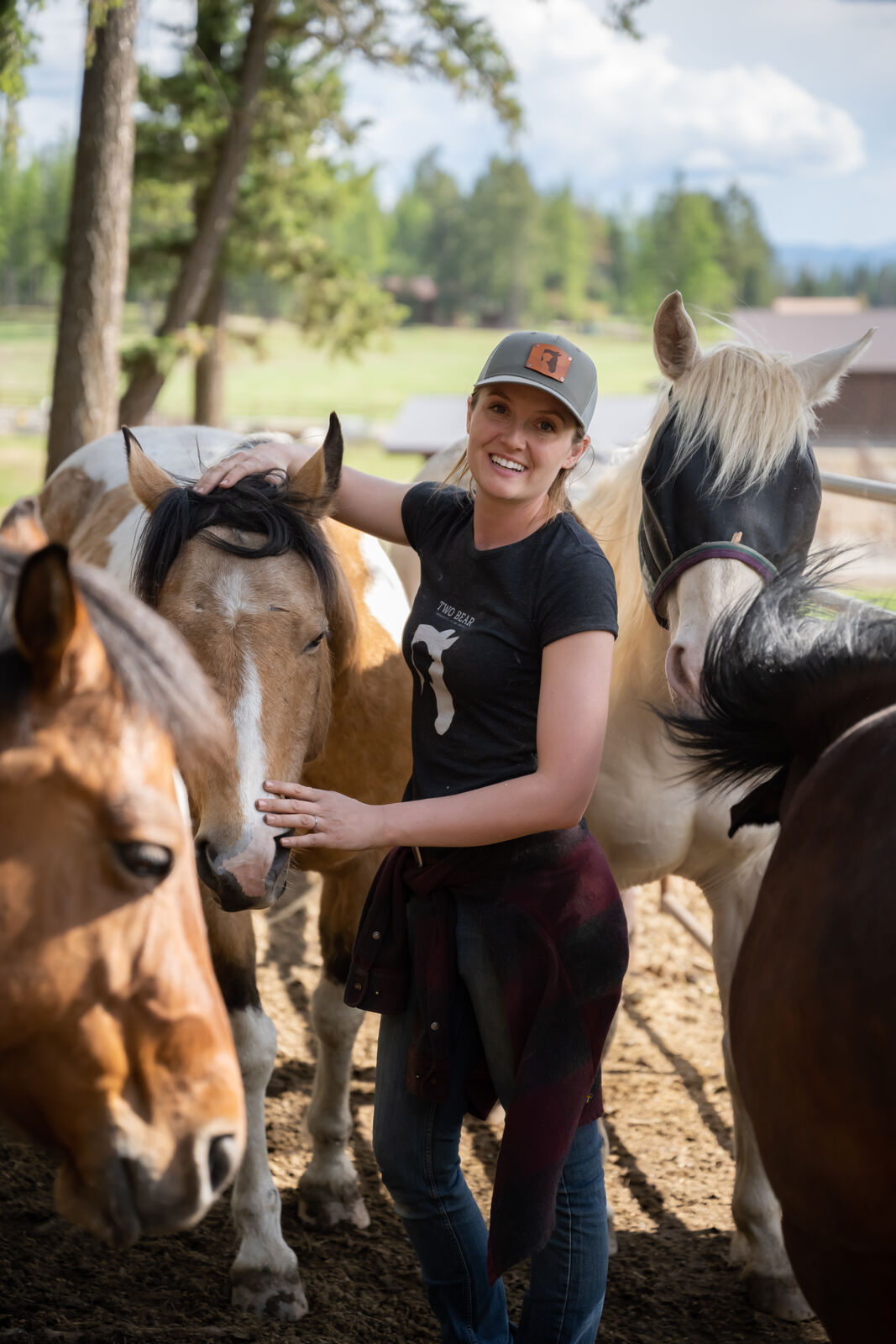
Kat is a recipient of the A Legacy of Legends horsemanship scholarship. Scholarship recipients are placed with a mentor, and Kat was placed with Dave Gamble of Standing Heart Ranch in Whitefish, who studied with Ray Hunt for seven years and with Buck Brannaman for over thirty, and who hosts Buck's annual clinic here in the valley. Standing Heart Ranch.
Which means the chain from Tom Dorrance to Lazy K is two people long, and it was assigned rather than assembled.
A Legacy of Legends was founded by Carolyn Hunt, Ray Hunt’s widow, together with Buck Brannaman, after Ray died in 2009. It exists for one reason: to keep the teaching from dying with the men who carried it. Every presenter is somebody who worked with Tom Dorrance or Ray Hunt directly, and the scholarships are the heart of it. Carolyn Hunt’s framing is that these people got the chance to learn from Tom or Ray, and it is now their turn to pass it to people who never will.
So the chain above is not a reading list. It is a line Kat was formally handed by the organization that exists to hand it on. That is also why this page sends you to their own sites rather than paraphrasing them: the tradition treats passing it forward as an obligation, not a product, and pointing you at the source is the same instinct.
Steve Peters is the join. He wrote Evidence-Based Horsemanship with Martin Black on the vaquero side and appears repeatedly on Warwick Schiller's podcast on the other. The same man gets cited by both wings, which is the best evidence there is that the two halves are describing one animal rather than two philosophies to pick between.
The six it’s built on
Tom Dorrance
1910 to 2003 · Oregon → CaliforniaThe root of the whole tree. Raised on a cattle ranch in the Wallowa country of northeastern Oregon, he never sought publicity, never had a program to sell, and wrote one book, and that only because his students pushed him into it. People called him the horse’s lawyer, because in any dispute between horse and human he took the horse’s side by default.
His contribution wasn’t a technique. It was a way of looking: the horse is always doing something for a reason, and nearly every training problem is a human problem showing up in the horse. Work with the whole horse: mind, body and spirit, not just the feet. And the trouble is almost never where you’re looking; it started earlier.
The question worth stealing: “What happened, before what happened happened?” That single question is the most useful thing an owner can carry into a problem. His other line: the human needs to think more and do less.
Start with: True Unity (his book) and the Feel, Timing and Balance video.
Bill Dorrance
1906 to 1999 · Mt. Toro Ranch, Salinas, CaliforniaTom’s older brother by four years, and the craftsman of the pair. He spent his last fifty years in the heart of California vaquero country as a working cattleman, a fine rawhide braider and a serious ranch roper. He was still riding at 92, walking with a cane on the ground and getting on horses anyway.
Bill’s whole subject is feel, and he was stubborn about it: feel is not a metaphor and not a mystical gift. It is a physical, learnable, teachable skill that runs both directions every second you are with the horse. He titled his book True Horsemanship Through Feel because, in his words, feel is the language of horses.
He also carried the bridle horse progression: snaffle, then hackamore (bosal), then two rein, then straight up in the bridle. It is a system for building a finished horse over years. When Lazy K says its horsemanship is vaquero rooted, this is the specific thing that means.
Start with: True Horsemanship Through Feel. It is the answer to “how long will this take?” Longer than you want, and the horses that got the time are the ones people notice.
Ray Hunt
1929 to 2009 · Idaho / TexasA working cowboy doing it the hard way until he bought a difficult horse named Hondo, asked Bill Dorrance about him, and got introduced to Bill’s brother Tom at the Elko County Fair around 1960. It reorganized how he understood the entire job.
Where Tom avoided the spotlight, Ray took the work public. From the mid 1970s he built the modern horsemanship clinic: the multi day format, the colt starting demonstration, the horseman with a microphone. He is credited with starting more than 10,000 colts across four continents. Without Ray, Tom Dorrance stays a legend among a few hundred ranch people.
The line everyone quotes: “Make the wrong thing difficult and the right thing easy.” Note both halves. Most people do the first and forget the second. Making the right thing easy means an honest, immediate, complete release. His other correction, and the one most amateur riders need: do a little bit often.
Buck Brannaman
b. 1962 · Sheridan, WyomingA child trick roping performer under a severely abusive father, removed from the home and placed with a foster family on a Montana ranch. That was the pivot point of his life and, not incidentally, of his horsemanship. He met Ray Hunt as a young man and later worked with both Dorrance brothers.
Buck’s addition to the lineage is structure: Tom was the philosopher, Ray was the catalyst, and Buck built the curriculum: a repeatable sequence an ordinary person can learn without losing the feel underneath it. Having come out of real violence, he is unusually credible on the difference between firmness and anger.
He inspired the central character in The Horse Whisperer and was lead equine consultant on the 1998 film; the 2011 documentary Buck won the Audience Award at Sundance. He runs a clinic in the Flathead Valley every November, which makes him the rare name on this page you can go and watch in person.
Start with: the documentary Buck, then 7 Clinics Discs 1 and 2 for the groundwork order. Note that Disc 2 includes a chapter on over-desensitizing, a warning from inside the tradition that matters.
Tristan Tucker and the TRT Method
Cornwall → Australia → NetherlandsThe modern branch, and the most directly transferable idea on this page. Tucker came up through pony club, eventing, racetrack and harness work, then studied classical training and circus style body control in Europe from 1999.
His premise: the horse lives in a human environment full of things their instincts read as lethal: trailers, clippers, crowds, tarps, being alone. The traditional answers are to control the horse or desensitize them until they stop reacting. Tucker’s answer is a third thing: give the horse a physical pattern they can go to when they’re worried, so under pressure they choose the pattern instead of flight.
The horse isn’t being made calm. The horse is being taught how to make themselves calm, and then that skill gets tested under progressively harder pressure. If your problem list includes trailer loading, clipping, spooking on the trail, separation anxiety or standing for the farrier, this is the relevant work.
Warwick Schiller and Attuned Horsemanship
New South Wales → CaliforniaA reining trainer who competed at the top of the sport. He was NRHA Reserve World Champion in 2002, and he represented Australia at the 2010 and 2018 World Equestrian Games. He built a large following teaching conventional, well organized natural horsemanship on YouTube from 2011.
Then he changed his mind in public, which is the interesting part. A horse named Sherlock, a superb athlete who did everything asked with his heart nowhere in it, was the most shut down horse he had worked with. Working through it, he concluded that Sherlock was shut down and so was he. In 2017 he set the training aside for most of a year and started over.
What came out of that is nervous system literacy: reading the horse’s state rather than their obedience, watching for the signs of genuine relaxation, and naming learned helplessness, the vocabulary for “your last trainer didn’t fix him, he just gave up.” He dismantled a successful method in front of his own paying audience, which cost him something and is worth respecting.
Start with: his material on the signs of relaxation. It’s the single most teachable observation skill here. You can learn to spot it in one session and it permanently changes how you see your horse.
The working line, the science, and the proof
These six shape how the work gets taught and explained. Between them they cover the hand to hand transmission from the Dorrances, the neuroscience underneath it, and a competition record that answers the obvious objection.
Dr. Steve Peters
Neuropsychologist · equine brain scienceThe one person here who came to horsemanship from outside it: a clinical neuropsychologist who turned the tools of human brain science on the horse. Residency and fellowship in neurorehabilitation, neurology and neurosurgery; founded and directed hospital memory clinics; has taught at the Spanish Riding School in Vienna and collaborated with Dr. Temple Grandin.
His contribution compresses into four words: “Fear shuts down learning.” Not as a slogan. As neurology. A horse in a sustained stress response is running the wrong circuitry to acquire anything; whatever you think you are teaching in that state, you are not teaching it.
He wrote Evidence-Based Horsemanship with buckaroo Martin Black, and appears repeatedly on Warwick Schiller’s podcast. The same man is cited by the vaquero wing and the modern wing, which is the structural proof that both halves are describing one animal.
He is also the answer to the skeptic who thinks slow work is coddling. You don’t win that conversation with philosophy; you win it with cortisol.
Martin Black
Bruneau, Idaho · fifth generation rancherThe Great Basin buckaroo tradition with a living pedigree, not a style he adopted, a family he was born into. Five generations of Blacks have raised and trained horses in Idaho’s Bruneau Valley; his great grandfather was born in a wagon in 1875 and sold thousands of horses to western ranches and the U.S. Cavalry.
He started his first colt at twelve, worked ranches in Idaho, Nevada and California alongside top bridle men including Ray Hunt and Tom Dorrance, and has won major ranch horse events including a Ranch Horse Association of America National Championship.
His addition is the working standard. Everything in this lineage was born on ranches, but Martin is the one who is unmistakably a stockman first, and his horsemanship is judged by whether the horse can do a day’s work, which is a harder and more honest test than whether they look soft in a round pen. He is also the horseman half of Evidence-Based Horsemanship.
Joe Wolter
Aspermont, Texas · summers near Ballantine, MontanaOne of very few people who worked closely with Ray Hunt, Bill Dorrance and Tom Dorrance, all three of them. He worked for Ray at Soldier Meadows Ranch in Nevada, then took a job in Salinas that put him next to Bill Dorrance, and together they ran some of the earliest ranch roping clinics ever held. He won the inaugural AQHA Versatility Ranch Horse competition in 2002.
He is also proof that softness is not an arena luxury: he learned it on a Nevada outfit, refined it with a rope in his hand, and then went and won with it.
The best three word teaching line in this whole tradition is his: “Reward with rest.” Beginners understand it immediately, it’s impossible to misapply into something harsh, and it’s the entire release principle in a phrase a nervous rider can hold onto in the moment.
Bryan Neubert
Alturas, CaliforniaThe shortest path back to the source. In his teens he became friends with his neighbor Bill Dorrance and spent every hour he could with him, working horses and braiding rawhide. After college he worked with Bill steadily, and met Ray Hunt and Tom Dorrance in that period.
Then the detail that sets him apart: Bryan traveled with Tom Dorrance as Tom began giving clinics in the 1970s. He was present at the founding of the clinic tradition, alongside the man it came from.
His contribution is transmission with the least distortion. He is not building a brand or a method with a name, he is passing along as plainly as he can what he was shown. He is also a noted rawhide braider: reatas, bosals, hackamores, romal reins. In the vaquero tradition the gear and the horsemanship were never separate subjects.
Start with: The First Week. Seven plus hours of the actual, unglamorous first week with young colts, the part almost every other video skips.
Nick Dowers
Dyer, Nevada · Dowers RanchThe youngest generation here, and the answer to the goal oriented client. Trained by Bryan Neubert and Joe Wolter, and then went and won Road to the Horse three times: 2016, 2019 and 2026, plus an NRCHA Open Snaffle Bit Futurity championship and over a million dollars in lifetime earnings.
The ten year span matters more than the count. That is a method holding up over a decade, not a hot streak, and it settles the “does soft actually compete?” question without needing an argument.
His phrase is the best short description of what this whole tradition is aiming at: “getting his thought to become my thought.” Not making the horse do it. Getting to where the horse wants the same thing.
And one who doesn’t have a website
The farrierKat names her farrier among her influences, alongside all the people above. That is worth saying out loud, because it says something true about where she thinks knowledge actually comes from.
The names on this page are studied on video and in books. A farrier who has stood under her horses for years is direct instruction, and the farrier visit is the most honest test any training program faces. It is a stranger, on a schedule, asking a horse to give up all four feet and stand still while somebody works on them. A horse either was taught to handle that or they weren’t, and no amount of arena polish covers the difference.
Most working farriers have no public footprint at all, which is normal, and is not a reason to think less of the influence.
Where to start
- Watch Buck (2011). Ninety minutes, widely available, and it will tell you more about what this kind of horsemanship looks like than anything written down.
- Read True Horsemanship Through Feel (Bill Dorrance) or True Unity (Tom Dorrance). Slow going on purpose. Both are the real thing.
- Look up Warwick Schiller on the signs of relaxation. Free, immediately usable, and the fastest change you can make to how you see your own horse.
And if you want to see it in person: Buck Brannaman runs a clinic in the valley every November. Recommending somebody else’s clinic is not a lost sale. It’s the whole point.
Want this applied to your horse?
That’s the job. Call or text and tell Kat what’s going on.